


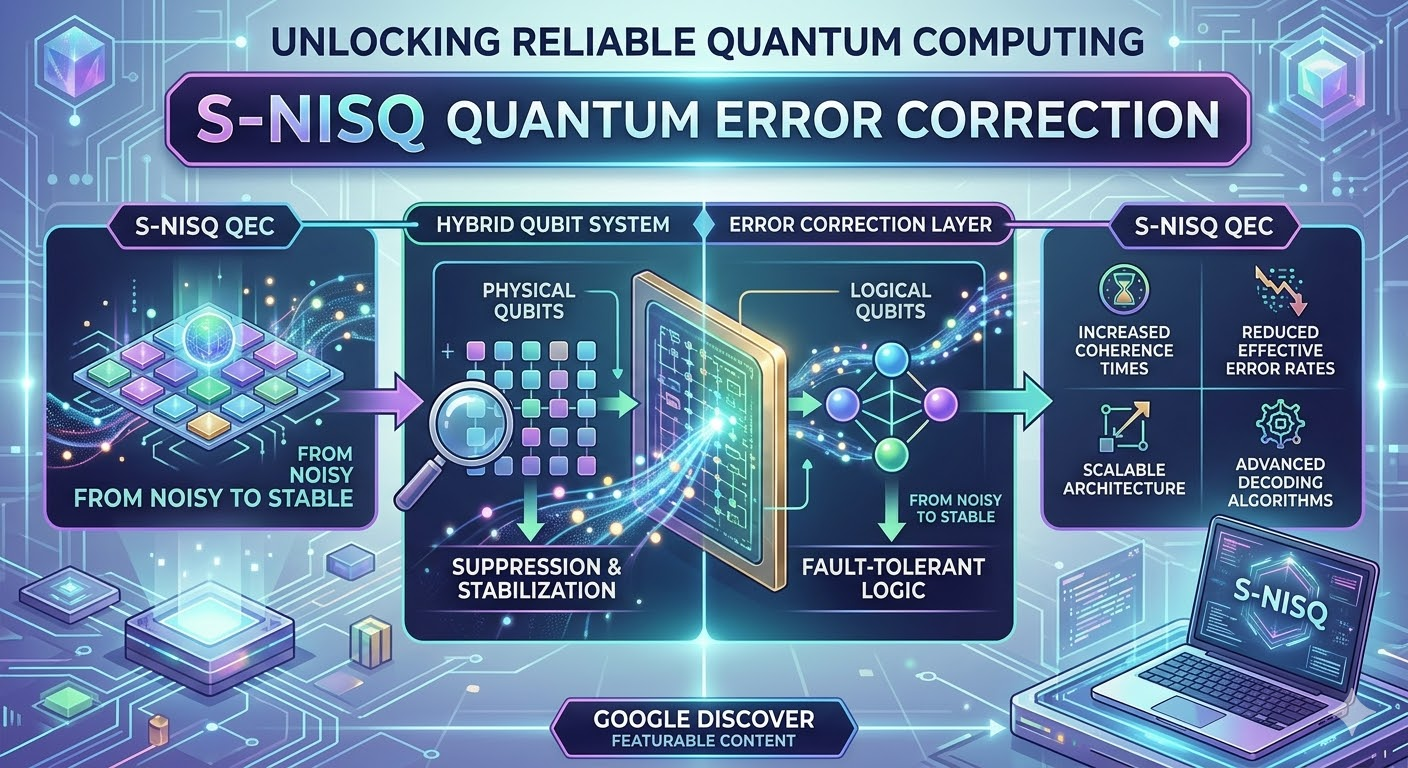
Quantum computing holds enormous promise for solving problems beyond the reach of classical machines. However, the delicate nature of quantum systems means that errors are inevitable during computation. s-nisq quantum error correction is an innovative approach designed specifically for near-term devices, or NISQ (Noisy Intermediate-Scale Quantum) machines. By selectively encoding critical qubits and optimising resources, s-nisq quantum error correction enhances computational reliability while remaining practical for existing hardware limitations.
Unlike conventional quantum error correction methods, which often require extensive qubit resources and complex operations, s-nisq quantum error correction focuses on efficiency. It allows researchers to maintain the accuracy of computations without overloading limited qubit counts. This targeted approach is crucial for advancing quantum experiments in areas like chemistry simulations, optimisation problems, and algorithm development, ensuring that near-term devices can produce meaningful and trustworthy results.
Understanding Quantum Errors in NISQ Devices
Errors in quantum computers are a natural consequence of the fragile quantum states used to store and process information. Qubits are extremely sensitive to external disturbances, including thermal fluctuations, electromagnetic interference, and imperfections in gate operations. s-nisq quantum error correction tackles these challenges by focusing protection on the most vulnerable qubits, minimising the impact of noise while preserving computational efficiency.
NISQ devices, which typically have fewer than a few hundred qubits, face a significant constraint in implementing traditional error correction codes. Conventional methods such as Shor or surface codes require substantial overhead, making them impractical for current hardware. By contrast, s-nisq quantum error correction uses lightweight, selective encoding techniques, enabling smaller quantum systems to achieve robust error mitigation without the need for full-scale fault-tolerant infrastructure.
What is s-nisq quantum error correction?
s-nisq quantum error correction is a tailored approach to protecting quantum information in the NISQ era. Instead of applying universal error correction codes across all qubits, it targets those most susceptible to errors. This selective protection reduces the required number of physical qubits while maintaining computational integrity. By doing so, s-nisq quantum error correction ensures that near-term quantum devices can carry out experiments that were previously considered too error-prone to be feasible.
The methodology behind s-nisq quantum error correction involves careful analysis of qubit behaviour, error patterns, and algorithmic requirements. Adaptive correction strategies allow real-time monitoring and response to emerging errors, further enhancing the reliability of computations. As a result, s-nisq quantum error correction serves as a bridge between experimental quantum research and the long-term goal of fully fault-tolerant quantum computing, providing practical solutions for today’s hardware.
Techniques and Methods in s-nisq quantum error correction
Implementing s-nisq quantum error correction requires specialised techniques that balance protection with efficiency. Selective logical encoding is central, focusing on qubits most likely to introduce significant errors. Error detection and mitigation strategies help identify problematic qubits during computation, while adaptive protocols dynamically adjust protection based on real-time feedback. This combination ensures that resources are used efficiently without sacrificing reliability.
Many researchers are now integrating s-nisq quantum error correction into quantum algorithms. By optimising error correction based on the specific structure of the computation, these methods reduce unnecessary overhead while improving overall accuracy. Real-world applications, such as quantum simulations of molecular structures or optimisation algorithms, benefit from s-nisq quantum error correction, allowing near-term quantum devices to deliver results previously achievable only on fault-tolerant systems.
Scalability Challenges and Solutions
One of the main limitations of s-nisq quantum error correction lies in scalability. As the number of qubits increases, maintaining selective protection without excessive overhead becomes more complex. s-nisq quantum error correction addresses this by employing lightweight encoding techniques that can scale efficiently with device size, ensuring that qubit resources are used optimally without sacrificing reliability.
Innovative approaches such as adaptive coding, error monitoring, and selective qubit prioritisation enhance scalability further. By focusing computational resources on the qubits most critical to algorithm success, s-nisq quantum error correction allows near-term devices to handle larger computations. This scalability ensures that NISQ-era quantum computers remain relevant for practical applications, even as hardware complexity increases over the coming years.
Applications and Impact
The applications of s-nisq quantum error correction span both research and emerging industries. Near-term quantum computers equipped with these techniques can perform simulations for chemistry, finance, and material science, where classical computation is limited. s-nisq quantum error correction enables accurate experimentation, offering insights into quantum behaviour and algorithm performance that are crucial for scientific and commercial advancement.
In addition to improving reliability, s-nisq quantum error correction provides a testing ground for future quantum computing strategies. By learning how near-term devices respond to selective error correction, researchers can refine methods that will later be applied to larger, fault-tolerant quantum systems. This ongoing development positions s-nisq quantum error correction as a cornerstone for bridging the gap between experimental and fully scalable quantum computing.
Future of s-nisq quantum error correction
Looking forward, s-nisq quantum error correction is poised to play a central role in quantum computing’s evolution. Researchers are exploring hybrid strategies that combine selective error correction with partial fault-tolerant designs, creating systems that are both accurate and resource-efficient. Such developments will enable NISQ devices to tackle increasingly complex problems while preparing for the eventual transition to fully fault-tolerant quantum machines.
As quantum hardware continues to improve, s-nisq quantum error correction will adapt alongside it. New techniques and algorithmic optimisations will ensure that near-term quantum computers remain valuable tools for experimentation and early-stage applications. This adaptability highlights the importance of s-nisq quantum error correction not only for current devices but also for shaping the long-term trajectory of quantum computing research.
Conclusion
s-nisq quantum error correction represents a practical and scalable solution for enhancing the reliability of near-term quantum computers. By selectively protecting qubits and optimising resource usage, it enables NISQ devices to perform meaningful computations that were previously prone to error. As research continues, s-nisq quantum error correction will remain vital for bridging the gap between today’s experimental devices and the future of fault-tolerant, large-scale quantum computing.

